
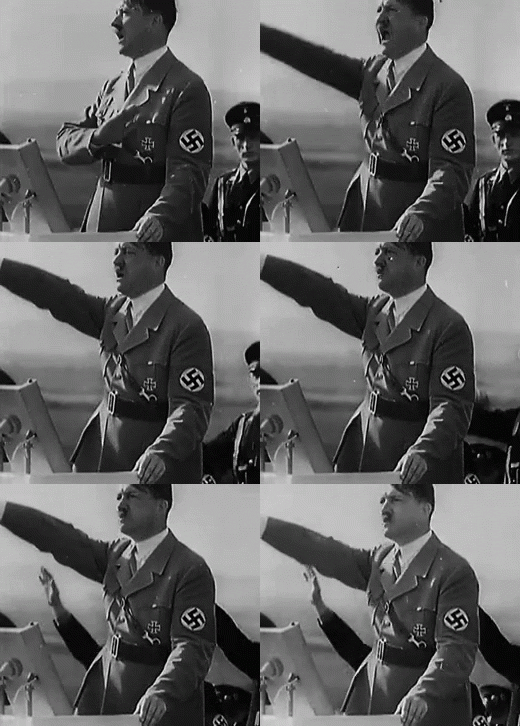
On April 1st, 1924, I began to serve my sentence of detention in the
Fortress of Landsberg am Lech, following the verdict of the Munich
People's Court of that time.

After years of uninterrupted labour it was now possible for the first
time to begin a work which many had asked for and which I myself felt
would be profitable for the Movement. So I decided to devote two volumes
to a description not only of the aims of our Movement but also of its
development. There is more to be learned from this than from any purely
doctrinaire treatise.

This has also given me the opportunity of describing my own development
in so far as such a description is necessary to the understanding of the
first as well as the second volume and to destroy the legendary
fabrications which the Jewish Press have circulated about me.

In this work I turn not to strangers but to those followers of the
Movement whose hearts belong to it and who wish to study it more
profoundly. I know that fewer people are won over by the written word
than by the spoken word and that every great movement on this earth owes
its growth to great speakers and not to great writers.

Nevertheless, in order to produce more equality and uniformity in the
defence of any doctrine, its fundamental principles must be committed to
writing. May these two volumes therefore serve as the building stones
which I contribute to the joint work.

The Fortress, Landsberg am Lech.


At half-past twelve in the afternoon of November 9th, 1923, those whose
names are given below fell in front of the FELDHERRNHALLE and in the
forecourt of the former War Ministry in Munich for their loyal faith in
the resurrection of their people:

Alfarth, Felix, Merchant, born July 5th, 1901
Bauriedl, Andreas, Hatmaker, born May 4th, 1879
Casella, Theodor, Bank Official, born August 8th, 1900
Ehrlich, Wilhelm, Bank Official, born August 19th, 1894
Faust, Martin, Bank Official, born January 27th, 1901
Hechenberger, Anton, Locksmith, born September 28th, 1902
Koerner, Oskar, Merchant, born January 4th, 1875
Kuhn, Karl, Head Waiter, born July 25th, 1897
Laforce, Karl, Student of Engineering, born October 28th, 1904
Neubauer, Kurt, Waiter, born March 27th, 1899
Pape, Claus von, Merchant, born August 16th, 1904
Pfordten, Theodor von der, Councillor to the Superior Provincial Court,
born May 14th, 1873
Rickmers, Johann, retired Cavalry Captain, born May 7th, 1881
Scheubner-Richter, Max Erwin von, Dr. of Engineering, born January 9th,
1884
Stransky, Lorenz Ritter von, Engineer, born March 14th, 1899
Wolf, Wilhelm, Merchant, born October 19th, 1898

So-called national officials refused to allow the dead heroes a common
burial. So I dedicate the first volume of this work to them as a common
memorial, that the memory of those martyrs may be a permanent source of
light for the followers of our Movement.

The Fortress, Landsberg a/L.,

October 16th, 1924


